Why the Khiva City Walls Define Central Asia’s Most Complete Walled City
The Khiva city walls stand as one of the most complete and impressive examples of medieval Islamic fortifications in Central Asia. Here’s what makes them extraordinary:
- Two concentric defensive rings: Ichan Kala (inner city) and Dichan Kala (outer city)
- Impressive dimensions: 8–10 meters high, 5–6 meters thick, with a 6.25 km perimeter
- Ancient origins: Foundations dating to the 5th century, with major construction in 1686-88 and 1842
- UNESCO World Heritage Site: Recognized in 1990 as Uzbekistan’s first protected site
- Walkable ramparts: Visitors can access sections for panoramic views of the old city
Rising from the desert sands of western Uzbekistan, these massive adobe walls have protected Khiva for over 1,500 years. From the outside, they resemble a giant sandcastle. Up close, they reveal centuries of history—from Mongol invasions to Silk Road glory to their role as the last caravan stop before the Iranian desert.
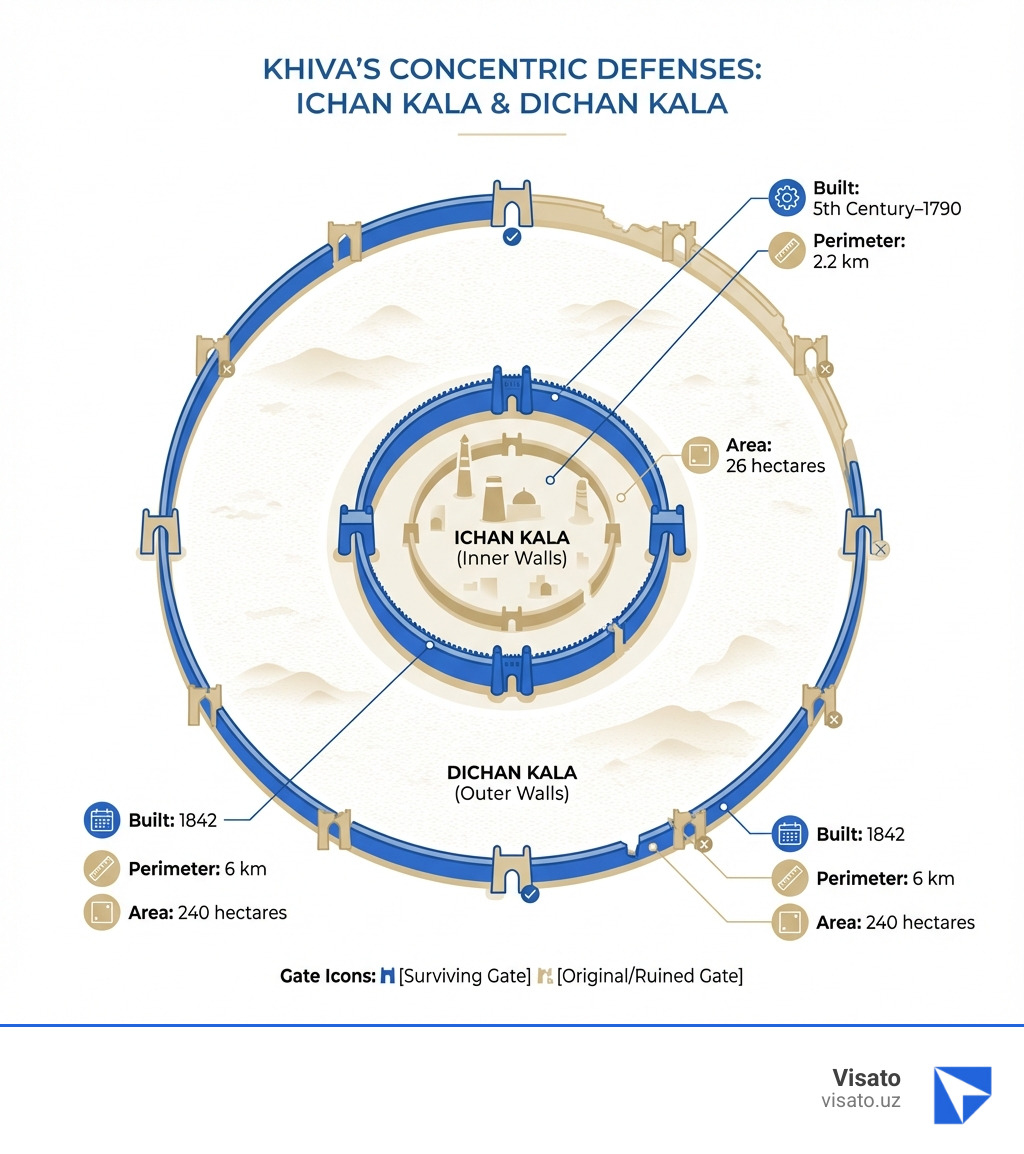
The walls tell two distinct stories. The inner Ichan Kala walls, rebuilt multiple times since antiquity, enclose 26 hectares of palaces, mosques, and madrasahs. The outer Dichan Kala wall, built in just 30 days in 1842 by 200,000 workers, once stretched 6 kilometers around the city’s suburbs and gardens. Today, the inner walls stand magnificently restored while the outer walls crumble into picturesque ruins.
I’m Nariman Huseynov, and through my work helping thousands of travelers obtain Uzbekistan e-visas, I’ve guided visitors to explore the Khiva city walls and understand why this walled city remains Central Asia’s best-preserved example of medieval urban planning. In this guide, I’ll walk you through everything you need to know about these remarkable fortifications—from their legendary origins to the best spots for sunset photography from the ramparts.
Quick Khiva city walls definitions:
A Tale of Two Walls: The History of Khiva’s Fortifications
When we speak of the Khiva city walls, we’re actually referring to two distinct, though historically intertwined, fortification systems: the inner Ichan Kala and the outer Dichan Kala. Each played a crucial role in shaping Khiva’s destiny, serving as formidable defensive barriers against invaders and as symbolic boundaries defining the city’s social and political landscape. Built primarily from mud bricks and adobe, these walls represent an enduring testament to ancient Central Asian engineering and resilience. Their construction timelines span centuries, marked by periods of destruction, rebuilding, and expansion, each layer adding to the rich mix of Khiva’s legends and history.
Ichan Kala: The Ancient Inner Fortress
The story of Khiva, and by extension its walls, often begins with a legend. Local lore tells us that the city was founded by Shem, a son of Noah, who, after finding sweet water in the desert, exclaimed “Khey-vakh!”—giving the city its name. This emphasis on water highlights Khiva’s miraculous existence as an oasis city, a vital stop on the Silk Road. Indeed, the very foundations of the Ichan Kala walls are believed to date back as far as the 5th century, a remarkable testament to the city’s ancient origins.
However, Khiva’s history is also one of trials by fire. In 1220, the formidable walls that then protected the city were tragically destroyed by Mongol invaders, a common fate for many Central Asian cities during that era. But like a phoenix from the ashes, Khiva always rebuilt. The strongest sections we see today were significantly fortified by Anusha Khan’s son, Arang Khan, between 1686 and 1688. This period marked a crucial phase of reinforcement, crucial for protecting the city from marauding Turkoman tribes who frequently threatened the region.
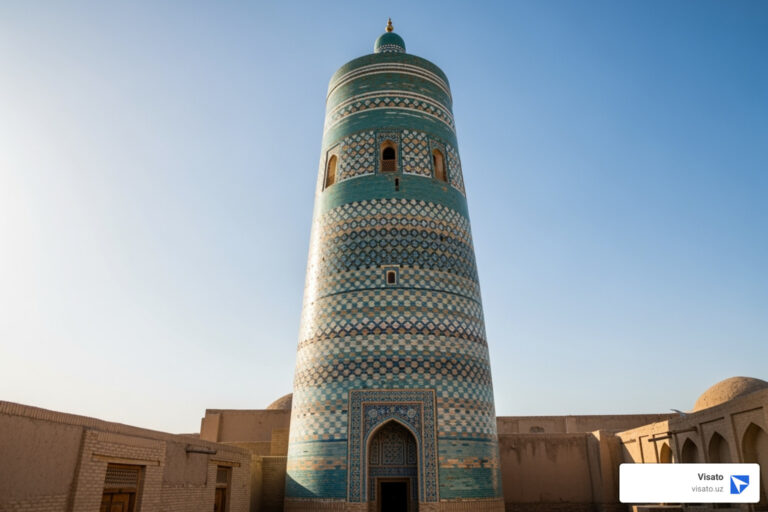
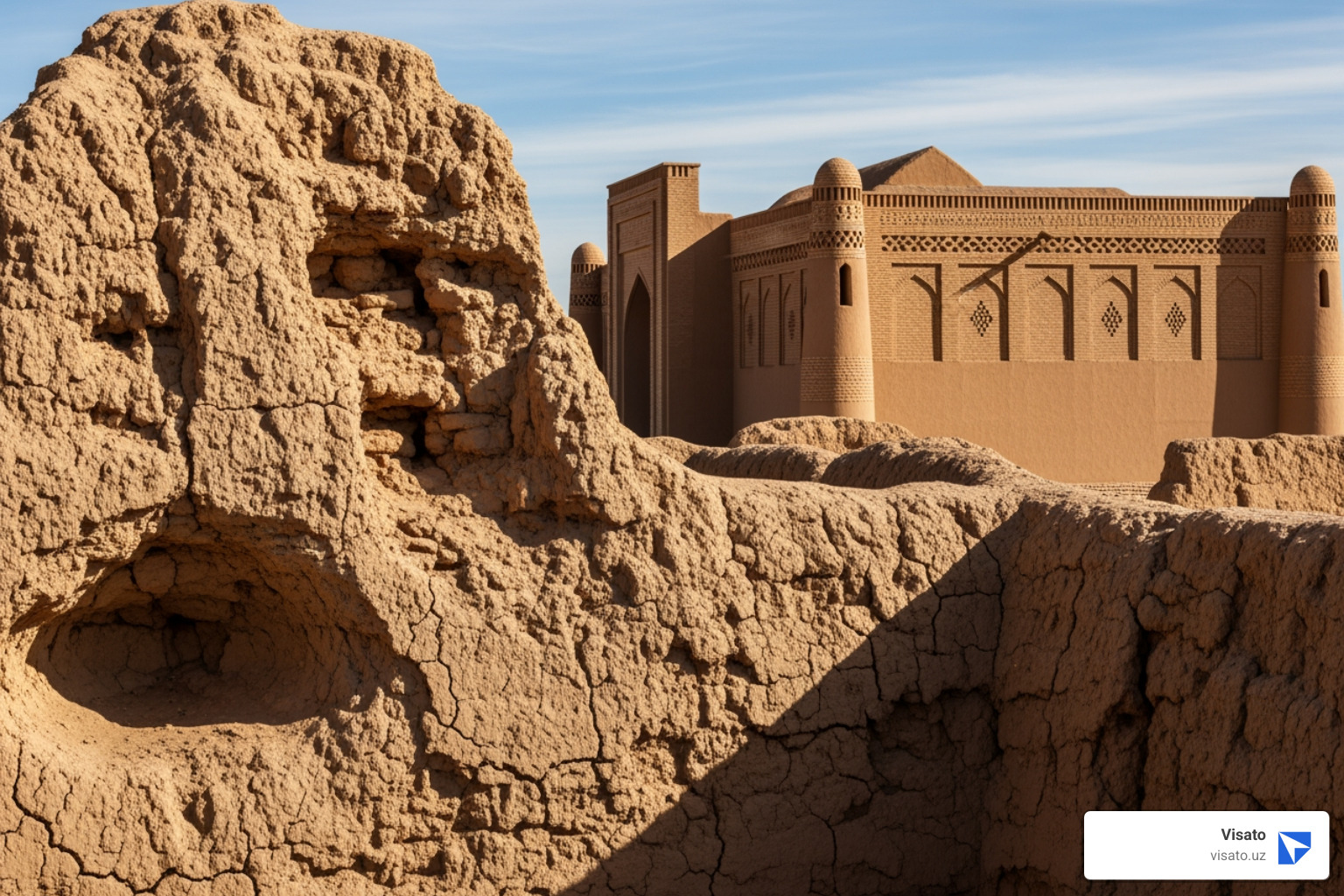
A major reconstruction effort took place in 1790, ordered by Khiva’s Khan Muhammad-Amin-Inak. This rebuilt section of the wall stretched approximately 1200 meters, standing 7-8 meters high and about 6 meters thick at its base. The construction material predominantly used was ‘pahsa’ adobe—a traditional Central Asian technique involving layers of rammed earth, which proved incredibly durable in the harsh desert climate. This inner fortress, the Ichan Kala, became the heart of Khiva, housing the Khan’s palace, the residences of high officials, clergy, and wealthy merchants, clearly demarcating the city’s elite core.
Dichan Kala: The Great Outer Wall
Beyond the inner sanctum of Ichan Kala lies the Dichan Kala, the “Outer Fortress.” This massive ring of fortifications was a later addition, constructed in 1842 under the order of Khiva khan Allahquli Khan. Its primary purpose was to expand the city’s defensive perimeter, offering protection to the growing suburbs, agricultural lands, and gardens that had developed outside the Ichan Kala. Specifically, it was designed to defend against external attacks, particularly from the Yomuts, a Turkmen tribe that posed a constant threat to the Khanate.
The construction of the Dichan Kala wall is a legendary feat of collective labor. Supervised by Mahammad Yakub Mekhtar, it was reportedly completed in an astonishing 30 days. This rapid construction was made possible by the ‘beghar’ tax—a form of government labor tax where volunteer workers were conscripted. Accounts suggest that approximately 200,000 people participated in its construction, demonstrating the Khan’s power and the community’s dedication to their city’s defense. The soil for this immense undertaking was dug out from an area two kilometers north of the city, which today is a large lake known as Govukkol.
The Dichan Kala wall stretched for an impressive 6 kilometers, encompassing three out-of-town gardens: Rafanik, Nurullabay, and Nurullabek. While much of this outer wall has unfortunately succumbed to time and neglect, its remnants still speak volumes about the city’s historical expansion and its continuous struggle for security in a volatile region. For more historical context on Khiva’s evolution, we recommend exploring resources like Khiva | City in Uzbekistan, History & Ichan-Kala.
Architectural Marvels: A Guide to the Khiva City Walls
The Khiva city walls are more than just defensive structures; they are architectural marvels that define the city’s character. Their imposing dimensions, intricate features, and historic gates offer a captivating glimpse into the past. As we walk along their ramparts or pass through their ancient doorways, we can almost hear the echoes of Silk Road caravans and the busy sounds of medieval life.
The Mighty Khiva City Walls: Dimensions and Design
The Ichan Kala walls, the most prominent and well-preserved, are truly impressive. They stand proudly at a height of 8–10 meters and are a formidable 5–6 meters thick at their base, gradually narrowing towards the top. The total perimeter of the Ichan Kala is approximately 2.2 kilometers, enclosing an area of 26 hectares. This roughly rectangular shape, measuring 650 by 400 meters, is a coherent and well-preserved example of traditional Central Asian urban planning.
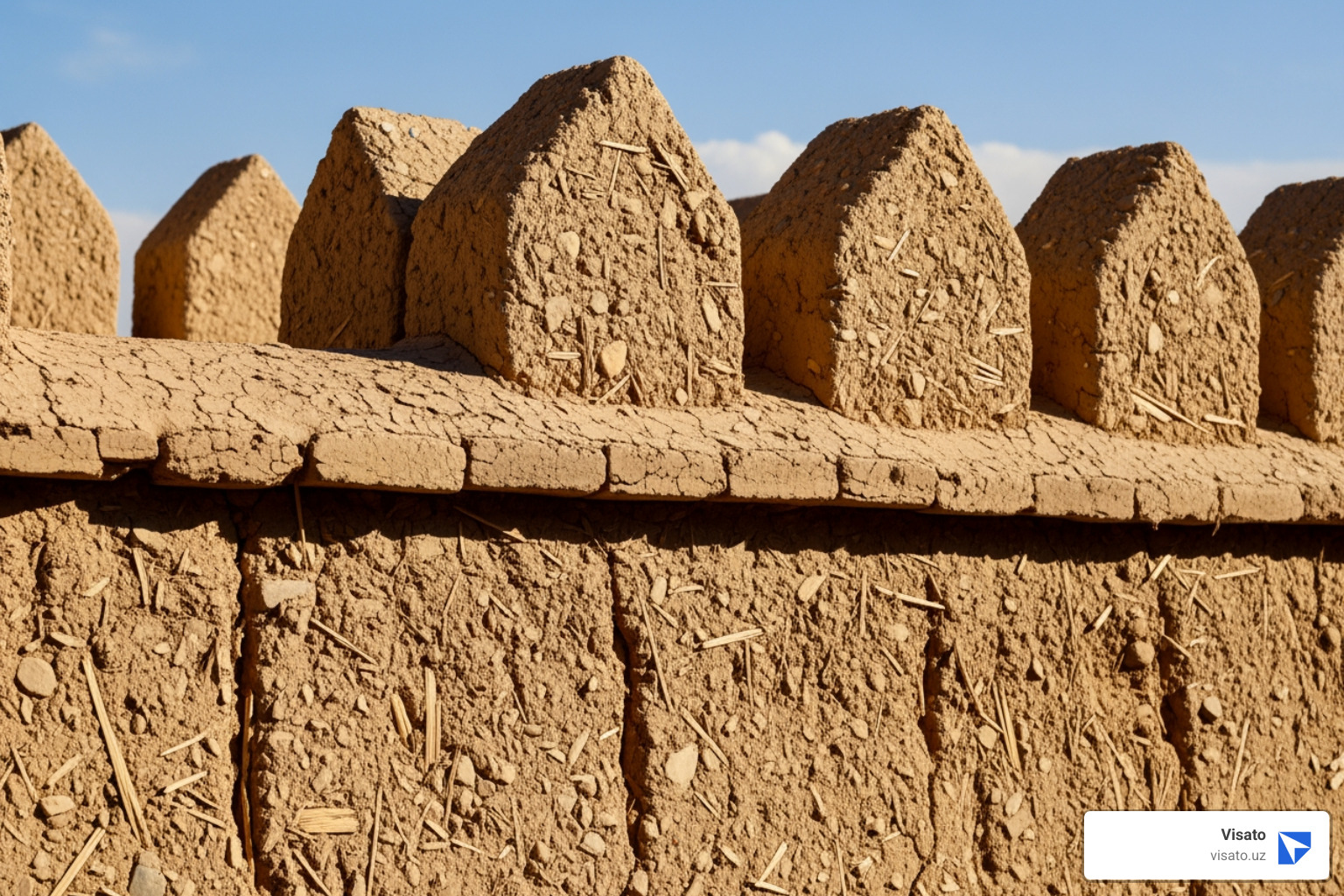
These monumental structures are primarily built from sun-baked mud bricks and ‘pahsa’ adobe, materials perfectly suited to the arid climate. Their design incorporates several key defensive features:
- Crenellated ramparts: The distinctive sawtooth pattern along the top of the walls provided cover for archers and defenders.
- Semicircular watchtowers: Strategically placed every 30-50 meters along the inner city walls, these turrets allowed for constant surveillance and provided additional strongpoints for defense. They often appear to support the wall with their abutments, adding to the structural integrity.
- Moats: While largely filled in or dried up today, historical accounts mention moats (water-filled canals) surrounding the walls, adding another layer of defense.
The construction of these walls was not merely functional; it was also a form of art. The rippled shape of the walls, especially when seen in the changing light of day, creates a dynamic and aesthetically pleasing appearance, making them resemble a grand, ancient mountain range.
Through the Gates of Time: Exploring Khiva’s Darvozas
Access to the Ichan Kala is granted through four monumental gates, known as Darvozas, each facing a cardinal direction and leading to different historical routes. These gates were not just entry points but vital hubs of commerce, defense, and social life.
The four main gates of Ichan Kala are:
- Ota Darvoza (West Gate): Often the first gate visitors encounter, it leads directly into the heart of the old city. It’s an imposing entrance that sets the tone for the historical wonders within.
- Bogcha Darvoza (North Gate): This gate, also known as Bakcha Darvasa, is a popular access point for visitors and often where we recommend starting a walk along the accessible sections of the walls.
- Polvon Darvoza (East Gate): Meaning “Hero Warrior’s Gate,” this was historically one of the most significant. It led towards the Amu Darya River and the ancient trade town of Khazarasp. Completed in 1806, it originally featured a gallery with six domes, serving as a busy shopping arcade. Tragically, this area was also notorious for hosting the Asian largest slave market, located just behind the Ichan Kala walls, and was a site for public executions.
- Tosh Darvoza (South Gate): Or “Stone Gate,” provided passage to the south.
The Dichan Kala, the outer wall, originally boasted ten gates. However, due to its less robust construction and the passage of time, only two of these have largely survived: the Hazorasp Gate and the Qosh Gate. These remaining outer gates, though less grand than those of Ichan Kala, still offer a glimpse into the city’s larger defensive perimeter. In eastern cities, the impressive appearance of gates was always of great importance, signifying the respect and recognition a city commanded, and these gates were often decorated with beautiful tiles, verses from the Qur’an, or inscriptions praising the ruling Khan.
Walking the Ramparts: The Best Views of Khiva
One of the most unforgettable experiences in Khiva is undoubtedly walking along the accessible sections of the Ichan Kala walls. We often suggest gaining access from the Bakcha Darvasa (North Gate). From here, a steep incline to the left leads towards the Kunya Ark, offering a unique perspective of the city.
From the ramparts, you’ll be treated to breathtaking panoramic views of the entire old town. The dozens of minarets, madrasahs, and mosques, with their intricate blue and green tiling, spread out below like a miniature kingdom. It’s from here that you truly appreciate the coherent and well-preserved urban ensemble of Ichan Kala.
For photographers, the best time to experience the walls is during the golden hour, just before sunset. The evening light casts a warm glow on the mud-brick structures, making the city walls especially impressive and creating stunning contrasts. Watching the sun dip below the horizon, painting the desert sky with vibrant colors while the city lights begin to twinkle below, is a truly magical experience. It’s a view that makes you feel as if you’re on a magic carpet ride, high above this ancient Silk Road jewel.
Preservation and Legacy: The Walls in the Modern Era
The Khiva city walls are not merely relics of the past; they are living monuments that continue to shape Khiva’s identity and attract visitors from across the globe. Their enduring presence is a testament to dedicated preservation efforts, yet they also face modern challenges that require ongoing attention.
Ichan Kala – UNESCO World Heritage Centre
Restoring a Masterpiece: Conservation Efforts
The international community recognized the outstanding universal value of Ichan Kala when it was inscribed as a UNESCO World Heritage Site in 1990. This designation brought increased attention and resources for the preservation of its architectural treasures, including the magnificent walls.
Conservation efforts have been ongoing for decades. Even during the Soviet era, there were periods where the walls were both damaged (sometimes used as raw material for brick production) and then later restored. More recent projects include an 80-meter section of the northern wall restored by UNESCO Uzbekistan in 2005, and another 140 meters repaired by the Ministry of Culture and Sports of Uzbekistan between 2008 and 2009. A 30-meter protection zone was established around the Dichan Kala wall in 2007, highlighting the commitment to preserving these fragile remnants.
However, the walls face continuous challenges inherent to their age and materials. Threats such as termite infestation, soil salinity, and humidity continue to affect the foundations and structure. Modern restoration techniques emphasize respecting traditional building methods and utilizing traditionally treated local materials like baked brick, wood, and stone to maintain authenticity. Ichan Kala’s legal status as a State Architectural and Historic Reserve since 1967, and its designation as a museum and reserve since 1969, underscore the commitment to its long-term preservation.
The Living Museum: Tourism and Identity
Today, the Khiva city walls are a powerful symbol of Khiva, central to its identity as a “museum city.” They are the first impression for many visitors and an integral part of the immersive historical experience. Unlike some other historical sites where ruins are merely observed from a distance, Khiva encourages interaction, allowing visitors to walk on sections of the walls and gain a unique perspective on the city. This direct engagement fosters a deeper appreciation for its history and architecture.
The walls also serve as a striking point of comparison with other historical fortifications in the region. For instance, while Bukhara also boasts ancient walls, Khiva’s wall completely encircles its entire Old Town, creating a more contained and cohesive historical environment, whereas Bukhara’s primary wall protected its palace. This complete enclosure gives Khiva an unparalleled sense of stepping back in time.
For locals, the walls are a source of immense pride, connecting them to a rich past and cultural heritage. They are a constant reminder of their ancestors’ ingenuity and resilience, acting as a living testament to Khiva’s enduring spirit. The walls play a crucial role in attracting the over 200,000 tourists, including nearly 7,000 international visitors, who flock to Khiva annually, contributing significantly to the city’s modern economy and cultural exchange.
Frequently Asked Questions about the Khiva City Walls
Can you walk on the city walls of Khiva?
Yes, absolutely! We highly recommend experiencing the Khiva city walls firsthand. Sections of the Ichan Kala walls are accessible to visitors, offering unparalleled panoramic views of the old city. The most popular and convenient access point is typically near the North Gate (Bogcha Darvoza). There’s usually a small fee to access these sections, but the breathtaking vistas, especially during sunset, are well worth it. You’ll gain a unique perspective on Khiva’s layout and its stunning architecture.
What is the difference between Ichan Kala and Dichan Kala?
The key difference lies in their location, purpose, and current state. Ichan Kala (meaning “inner fortress”) is the historic inner city, a compact, well-preserved UNESCO World Heritage site enclosed by its own robust walls. This was historically the administrative and elite residential core, housing the Khan’s palace, madrasahs, mosques, and the homes of prominent citizens. Its walls are largely restored and are the ones you’ll primarily explore.
Dichan Kala (meaning “outer fortress”) was the much larger outer wall, built later in 1842 to protect the city’s expanding suburbs, gardens, and agricultural lands from external threats like the Yomut tribes. While once a formidable 6-kilometer perimeter with 10 gates, it was less robustly constructed than Ichan Kala and has largely crumbled over time. Today, only scattered remnants and a couple of gates of Dichan Kala remain, offering a stark contrast to the perfectly preserved Ichan Kala.
How old are the Khiva city walls?
The history of the Khiva city walls stretches back over a millennium and a half! The original foundations of the Ichan Kala walls date back as far as the 5th century. However, the massive, imposing structures you see today are the result of numerous periods of rebuilding, fortification, and expansion. The strongest sections were added by Arang Khan’s son, Anusha Khan, between 1686 and 1688. A significant reconstruction of the Ichan Kala wall also occurred in 1790 under Khan Muhammad-Amin-Inak. The Dichan Kala, the outer wall, is a more recent addition, built in 1842. So, while their roots are ancient, the visible walls are primarily from the 17th to 19th centuries.
Conclusion: The Enduring Sentinel of the Silk Road
The Khiva city walls, both the majestic Ichan Kala and the crumbling but historically significant Dichan Kala, represent far more than just ancient fortifications. They are the guardians of a vibrant past, silent witnesses to centuries of trade, conquest, and cultural flourishing along the Silk Road. From their legendary origins tied to Noah’s son Shem to their strategic role in protecting Khiva’s Khans and its people, these walls have profoundly shaped the city’s identity.
Today, the walls have transitioned from formidable fortresses to iconic symbols, drawing travelers into a living museum where history breathes around every corner. Their preservation, a testament to dedicated local and international efforts, ensures that future generations can continue to marvel at this architectural heritage. As we look out from the ramparts, we don’t just see a city; we see a narrative of resilience, ingenuity, and enduring beauty.
At Visato.uz, we’re passionate about helping you find such incredible places. Our fast, simple, and secure online application process for your Uzbekistan e-visa means you can spend less time on paperwork and more time planning your unforgettable journey to Khiva. Let us handle the visa, so you can focus on exploring the wonders of this ancient walled city.
Ready to walk through history and experience the magic of Khiva for yourself? Plan your trip to Khiva and let the adventure begin!