Why Getting Your Uzbekistan Visa Photo Size Right Matters
Uzbekistan visa photo size is one of the most critical requirements that can make or break your visa application. Here’s what you need to know:
Quick Answer: Uzbekistan Visa Photo Size Requirements
| Requirement | Specification |
|---|---|
| Traditional Visa Size | 35mm x 45mm |
| E-Visa Size | 50mm x 50mm |
| Head Height | 34.5mm (chin to top of hair) |
| Face Coverage | 70-80% of photo |
| Background | Plain white or off-white |
| File Format | JPG/JPEG |
| File Size | 20KB to 1MB (digital) |
| Photo Age | Within last 6 months |
A single photo mistake can delay your entire visa application by weeks. Whether you’re applying for a traditional visa at an embassy or submitting an online e-visa application, your photo must meet strict specifications set by the Ministry of Foreign Affairs of the Republic of Uzbekistan.
The most common confusion? Different photo sizes for different visa types. Traditional visa applications require 35mm x 45mm photos, while e-visa applications need 50mm x 50mm dimensions. Many applicants also struggle with background requirements, facial expression rules, and digital file specifications.
Getting rejected because of a non-compliant photo is frustrating. You waste time, and in some cases, application fees. But the good news is that meeting these requirements is straightforward once you understand the exact specifications.
I’m Nariman Huseynov, and through our work at visato.uz over the past 5 years, I’ve helped thousands of travelers successfully steer Uzbekistan visa photo size requirements and other application challenges. This guide will walk you through every specification you need to know to get your photo right the first time.
Core Photo Specifications: Uzbekistan Visa Photo Size, Background, and Quality
Getting your visa photo perfect isn’t just about looking good; it’s about adhering to precise international standards that ensure your identity can be clearly verified. When it comes to your Uzbekistan visa application, the photo is a critical component, and we’re here to help you nail every detail.
Clarifying the Dimensions: Physical and Head Size
The first and arguably most important requirement is the Uzbekistan visa photo size. This isn’t a “close enough” situation; precision is key.
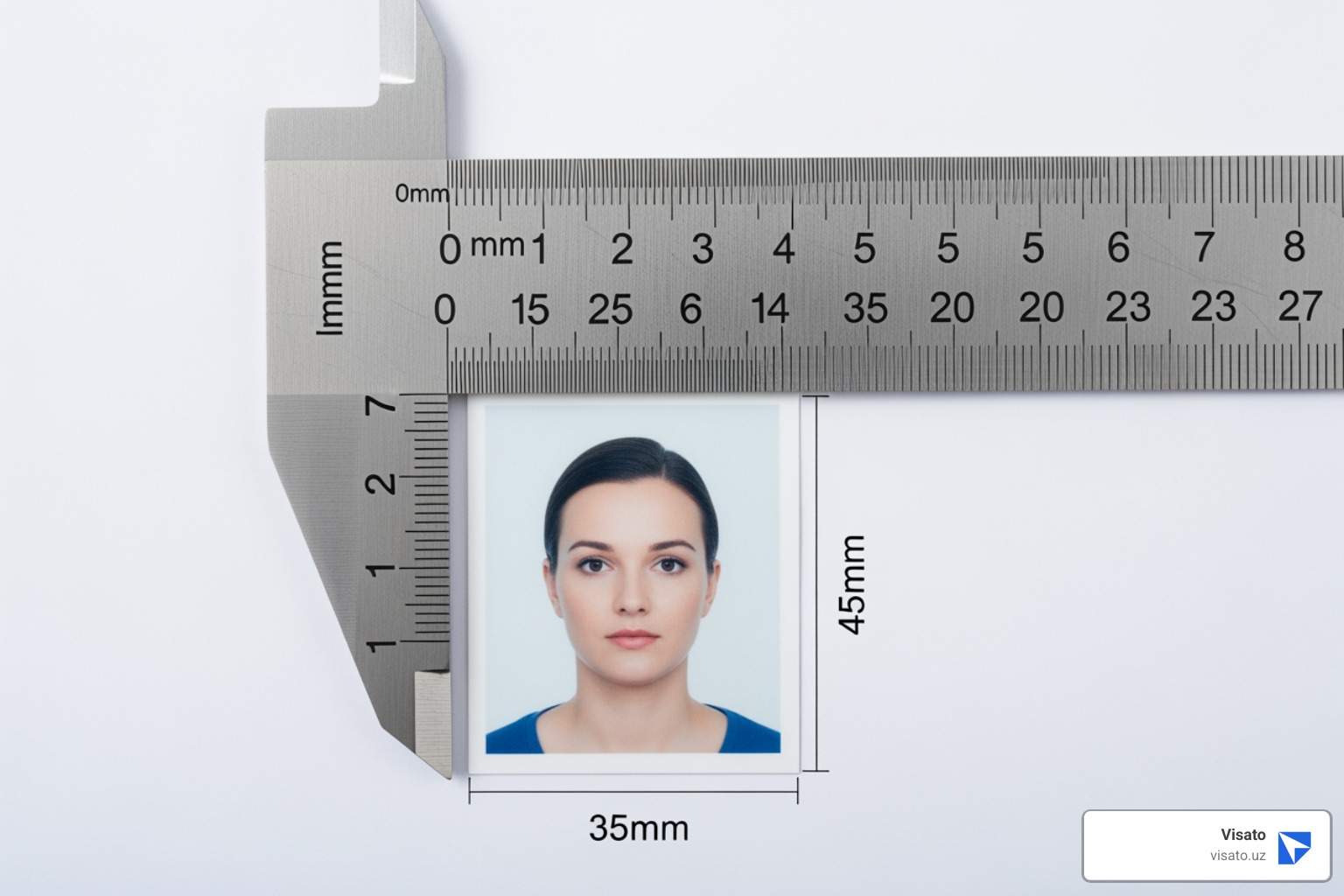
For traditional visa applications, the standard photo size is 35mm in width and 45mm in height. This is a common international standard, but it’s crucial to confirm this if you’re getting photos taken professionally.
However, for those applying for an Uzbekistan e-visa, the requirements shift slightly. Your digital photo must be 50mm x 50mm. This difference is significant and often overlooked, leading to unnecessary delays. Always double-check which type of visa you’re applying for to ensure you have the correct dimensions.
Beyond the overall photo dimensions, there are specific guidelines for how your face should fit within the frame:
- Head height: From the bottom of your chin to the top of your hair, your head should measure approximately 34.5mm.
- Top of hair to top of photo: There should be a gap of about 3mm from the very top of your hair to the top edge of the photo. This ensures proper framing and prevents your head from being cut off.
- Face occupancy: Your face should occupy a significant portion of the photograph, typically covering 70% to 80% of the total picture height. This ensures that your facial features are prominent and easily identifiable.
These precise measurements are designed to ensure consistency across all applications and aid in biometric identification. It might sound like a lot of numbers, but getting these right from the start saves a lot of headaches later on!
Background and Lighting Essentials
Imagine trying to pick out a face from a crowd. That’s essentially what immigration officials are doing, and a cluttered background or poor lighting makes their job much harder. That’s why the background and lighting for your Uzbekistan visa photo size are strictly defined:
- Background color: The background must be plain white or off-white. No patterns, no textures, no busy scenes from your last vacation! A solid, neutral color ensures your face stands out clearly.
- No shadows: This is critical. The lighting must be even across your face and the background. Shadows, especially behind your head or across your features, can lead to rejection. Avoid direct sunlight or harsh overhead lights that create shadows.
- Even lighting: The photo should be taken under proper lighting conditions, meaning your face should be uniformly lit, without any overly bright spots or dark areas.
- No glare or reflections: If you wear glasses (more on that later), ensure there’s no glare reflecting off the lenses. Similarly, any shiny surfaces in the background could cause reflections that distort the image.
The goal is to provide a clear, unobstructed, and unambiguous image of your face. A simple white or off-white background with even lighting is the easiest way to achieve this.
Photo Quality and Recency Standards
A blurry, old, or poorly printed photo is a surefire way to get your visa application sent back. The quality and recency of your Uzbekistan visa photo size are just as important as the dimensions:
- Recency: Your photo must be recent, taken within the last six months. This ensures that the photo accurately reflects your current appearance. Drastic changes in appearance (like significant weight loss/gain or facial surgery) might require a new photo even if the old one is technically within the six-month window. Minor changes like growing a beard or coloring your hair usually won’t require a new photo, as long as you are still easily identifiable.
- Color: The photo must be in color, not black and white.
- Sharp and clear: The image needs to be of high quality, sharp, and in focus. Any blurriness, pixelation, or graininess will likely lead to rejection.
- No digital alterations: While minor adjustments for brightness or contrast might be acceptable, do not digitally alter your photo to change your appearance, remove blemishes, or add filters. The photo should be an authentic representation of you.
- No red-eye: Ensure there’s no red-eye effect from the flash. If you’re using a flash, try to mitigate this effect by using anti-red-eye settings or adjusting your lighting.
- Printed on photo quality paper: If you’re submitting a physical photo, it must be printed on high-quality matte or glossy photo paper. Damaged photos with holes, creases, or smudges are unacceptable.
Think of your photo as your first impression. A high-quality, current image helps ensure a smooth application process.
Digital Photo Requirements for the Uzbekistan E-Visa
Applying for an e-visa to Uzbekistan offers convenience, but it comes with its own set of technical requirements for your photo. Since everything is submitted online, the digital specifications are paramount.
File Format and Acceptable Digital Uzbekistan Visa Photo Size
When submitting your photo for an Uzbekistan e-visa, it’s not just about the visual quality; the digital file itself needs to meet specific criteria:
- File format: The most commonly accepted file format is JPG or JPEG. Some sources also mention PNG or BMP, but JPG/JPEG is consistently listed. To be safe, we recommend sticking to JPG/JPEG unless the official e-visa portal explicitly states otherwise.
- File size: This is where things can get a little tricky, as our research shows slightly varying ranges. Some sources suggest the digital file size should be smaller than 240 KB, others indicate a range of 20 to 100 KB, and some even allow 200 KB to 1 MB. To ensure compliance, we advise aiming for a file size between 20 KB and 1 MB. However, always check the specific instructions on the official Uzbekistan e-visa portal (evisa.mfa.uz) just before you upload, as requirements can be updated.
- Resizing photos: If your photo is too large or too small in terms of file size, you’ll need to resize it. Many online tools or photo editing software can help you compress or resize images without significantly compromising quality. Just remember not to alter your appearance in the process!
These digital specifications are crucial for the system to process your application efficiently. A photo that’s too large might not upload, while one that’s too small might lose quality and be rejected.
Resolution and Scanning Best Practices
Beyond file size and format, the resolution of your digital photo is important for clarity.
- Recommended resolution (DPI): For an Uzbekistan visa photo, a resolution of 300 to 600 DPI (dots per inch) is generally recommended. This ensures that the image is sharp and detailed enough for official use.
- Scanning physical photos: If you have a physical photo that meets all the requirements and you need to digitize it for an e-visa application, follow these best practices for scanning:
- Scan one photo at a time.
- Ensure the scan is in color.
- Scan clearly so that the entire front of the photo is visible.
- Do not place the photo on another piece of paper during scanning, as this can create borders or shadows.
- Ensure the scanned image retains the original proportions and quality.
For more general guidance on photo best practices that often apply across various visa applications, you might find external resources helpful, such as the General photo best practices provided by the U.S. Department of State. While specific to U.S. visas, the advice on clarity, lighting, and composition is universally valuable.
Appearance and Pose: Getting Your Expression and Attire Right
Your photo needs to be a clear and accurate representation of you, free from distractions or ambiguities. This means paying close attention to your facial expression, what you wear, and any accessories.
Facial Expression and Gaze
This might seem straightforward, but it’s one of the most common pitfalls!
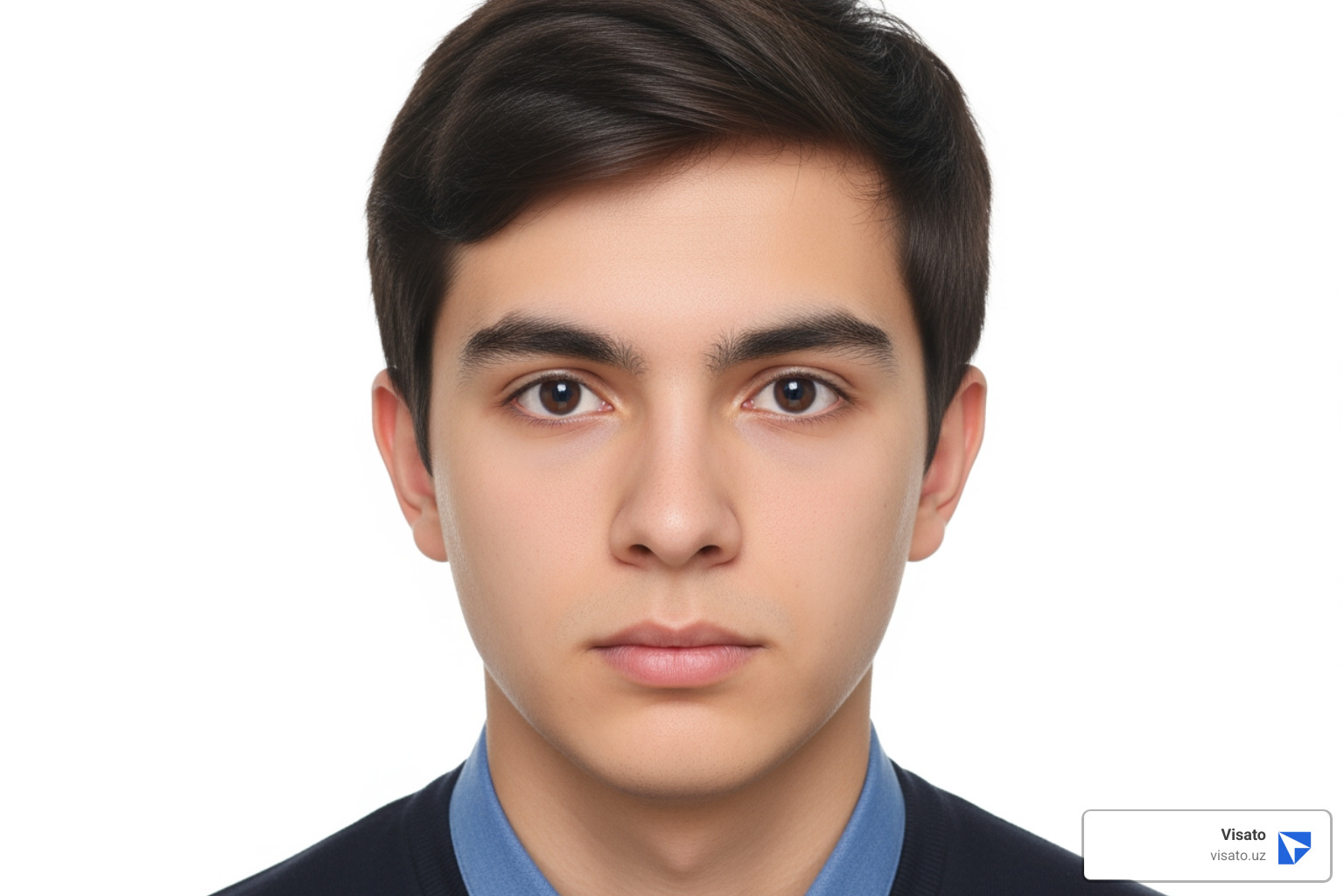
- Neutral expression: Maintain a neutral facial expression. This means no smiling, frowning, or exaggerated expressions. Your mouth must be closed, and your teeth should not be visible.
- Eyes open and visible: Both of your eyes must be open and clearly visible. Make sure no hair or glasses frames obstruct them.
- Looking directly at the camera: You should be facing the camera directly, with your head straight and not tilted. Your gaze should be focused straight ahead, into the lens.
- Face centered: Your face should be centered within the photograph, ensuring symmetrical framing.
The goal is a straightforward, unembellished portrait that allows for easy identification. Think of it as your official “mugshot” for travel, but a much friendlier version!
Guidelines for Glasses, Headwear, and Accessories
What you wear or carry can significantly impact your photo’s compliance.
- Eyeglasses: This is a tricky one, as some sources are stricter than others. Generally, glasses are not advised. However, if you must wear them for medical reasons, they are allowed under strict conditions:
- No tinted lenses.
- No glare or reflections on the lenses.
- Your eyes must be fully visible and not obstructed by the frames.
- You might need to provide a doctor’s note with your application if wearing glasses is medically necessary.
- Our advice? If you can take them off, do so. It eliminates any potential issues.
- Headwear: Hats or head coverings are generally not allowed unless worn daily for religious or medical reasons.
- If worn for religious purposes, you might need to provide a self-signed statement.
- If for medical reasons, a doctor’s certificate might be required.
- Crucially, even if allowed, the headwear cannot cast shadows on your face, and your full face must be visible from the bottom of your chin to the top of your forehead.
- Jewelry: Minimal jewelry is generally permitted, as long as it does not obstruct your face or cast shadows. Large, reflective, or distracting jewelry should be avoided.
- Accessories: No headphones or wireless hands-free devices are allowed in the photo. Keep it simple!
When in doubt, less is more. Removing potential distractions ensures your photo meets the strict guidelines.
What to Wear for Your Visa Photo
Your clothing choice might seem minor, but it’s another detail that helps ensure a compliant photo.
- Daily attire: You should wear clothing that you normally wear on a daily basis.
- Solid-colored clothing: Opt for solid colors that contrast with the white or off-white background. Avoid busy patterns, stripes, or very light colors that might blend into the background.
- No uniforms or costumes: Do not wear uniforms (e.g., military, police, or daily work uniforms like construction gear) or costumes. The photo should reflect your civilian appearance.
- Shoulders covered: While not always explicitly stated, it’s best practice to ensure your shoulders and chest are covered, avoiding overly casual or revealing clothing.
The aim is for your clothing to be non-distracting, allowing your face to be the sole focus of the photograph.
Special Considerations and Common Mistakes
Even with all the guidelines, some scenarios require extra attention, and certain mistakes pop up more often than others. We want to help you avoid them!
Photo Requirements for Infants and Minors
Applying for a visa for the little ones? There are specific considerations for children’s photos.
- Child alone in photo: The child must be the only person in the photograph. No parents, siblings, or even comforting hands should be visible.
- No toys or pacifiers: Ensure no toys, pacifiers, or other objects are visible.
- Facial expression: While a neutral expression with a closed mouth is ideal for older children, infants (babies under one year) are given a bit more leeway. Their eyes do not have to be fully open, but they should be as open as naturally possible. Their mouth should be closed.
- High quality: Just like adult photos, the photograph must be of high quality, sharp, and clear.
- Frontal photograph: The child must be facing directly forward, with a clear view of their entire face.
It can be a challenge to get a baby to pose perfectly, but patience and a good setup (like laying them on a plain white sheet) can make it easier.
Top 5 Common Rejection Reasons to Avoid
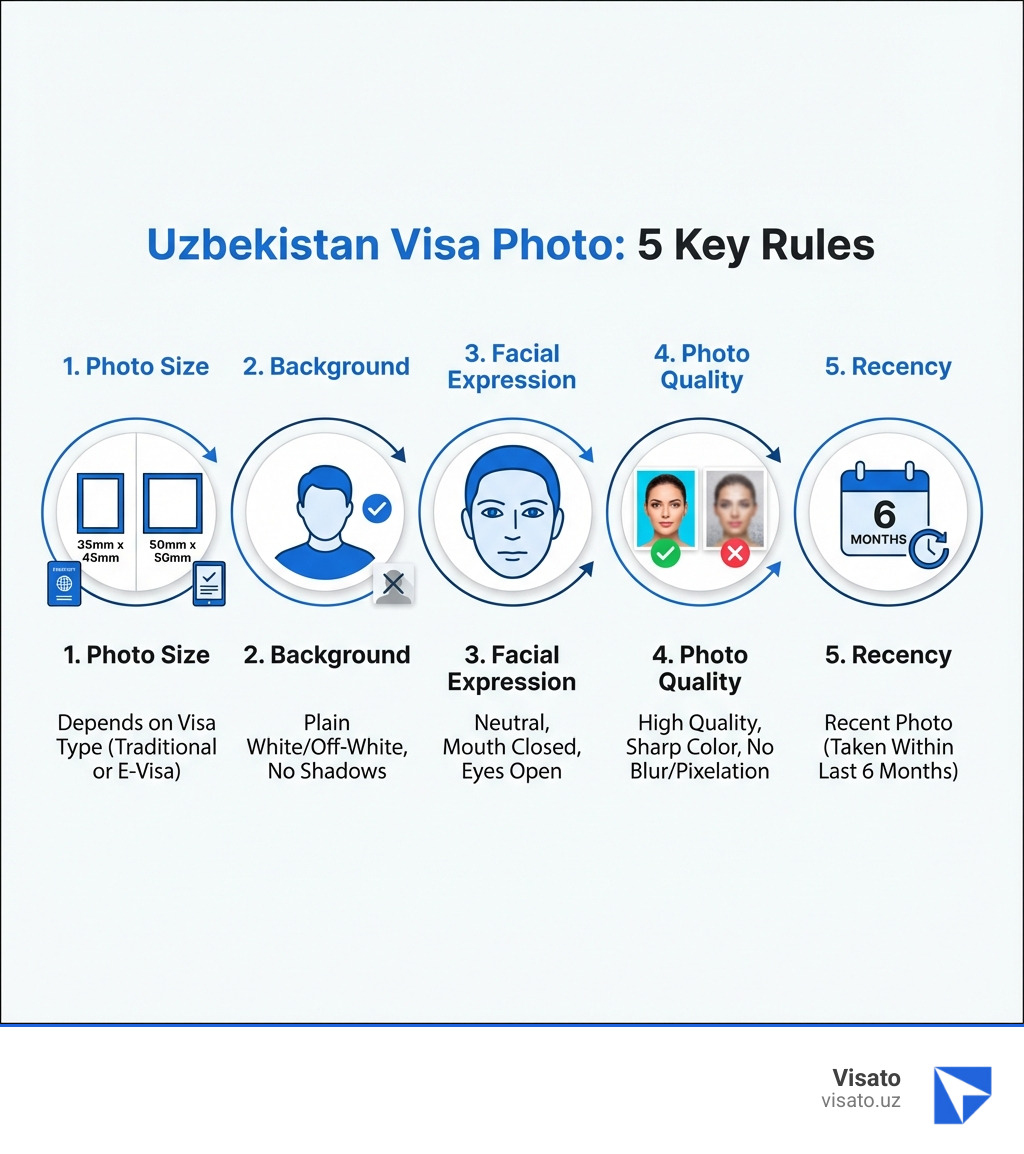
After processing countless visa applications at Visato.uz, we’ve seen the same mistakes crop up again and again. Here are the top 5 reasons your Uzbekistan visa photo size or quality might lead to rejection:
- Incorrect background color or shadows: Using a colored background, a patterned background, or having visible shadows behind your head or on your face. It needs to be plain white or off-white with even lighting.
- Wrong photo dimensions or head size: Submitting a photo that’s the wrong size (e.g., 35x45mm instead of 50x50mm for an e-visa, or vice-versa) or where your head doesn’t occupy the correct percentage of the photo. Precision here is key!
- Unacceptable facial expression (smiling): Flashing a big smile might be natural, but for visa photos, it’s a no-go. A neutral expression with a closed mouth is mandatory.
- Glare on glasses or eyes obscured: If you wear glasses, any glare on the lenses that obscures your eyes, or frames that cover a significant part of your eyes, will cause rejection. It’s safer to remove them if possible.
- Low-quality or edited image: Blurry, pixelated, or excessively edited photos (beyond minor brightness/contrast adjustments) are unacceptable. Your photo must be sharp, clear, and a true representation of your current appearance.
Avoiding these common pitfalls will significantly increase your chances of a smooth application process.
Conclusion
Navigating the specific requirements for your Uzbekistan visa photo size and quality might seem daunting at first, but with this guide, we hope you feel empowered and informed. We’ve covered everything from the precise dimensions for both traditional and e-visas to the crucial details about background, lighting, facial expression, and even what to wear.
Remember these key takeaways:
- Size matters: 35x45mm for traditional, 50x50mm for e-visas.
- Background is plain: Always white or off-white, with no shadows.
- Expression is neutral: Mouth closed, eyes open, looking straight ahead.
- Quality is paramount: Sharp, clear, recent (within 6 months), and in color.
- Digital details count: Correct file format (JPG/JPEG) and file size (20KB-1MB) for e-visas.
Getting your photo right the first time is a critical step towards a hassle-free Uzbekistan visa application. It avoids frustrating delays and ensures your travel plans stay on track.
At Visato.uz, we understand that every detail counts. That’s why we specialize in providing a fast, simple, and secure online application process for Uzbekistan e-visas, often delivering results in as little as 2-3 business days with 24/7 support. We’re here to help you through every step, ensuring your application, including your photo, meets all official requirements.
Ready to take the next step in your Uzbekistan adventure? For more detailed guidance, especially if you’re an Indian citizen planning your trip, check out our comprehensive resource: Get your Uzbekistan visa for Indians with our 2025 guide. We look forward to helping you make your journey a reality!