Why E-Visa Processing Time Matters for Your Travel Plans
E-visa processing time is the period from submission to approval of your online visa application. Understanding this timeline is crucial for stress-free travel. E-visas are much faster than traditional embassy applications, but processing times vary widely. It can be 24 hours for a New Zealand NZeTA or three weeks for a multiple-entry visa to the Philippines. The final timeline depends on your destination, visa type, and application accuracy.
Quick Answer: E-Visa Processing Times by Country
| Country | Processing Time | Entry Type |
|---|---|---|
| India | 4 days average | Tourist/Business |
| Vietnam | 4-5 working days | Standard |
| New Zealand (NZeTA) | 24 hours average (allow 3 days) | Tourist |
| Philippines | 7-12 working days | Single entry |
| Philippines | 15-21 working days | Multiple entry |
| Japan | At least 5 business days | Tourism only |
| Thailand | Within 10 business days | Various types |
Key Factors:
- Most e-visas take 4-21 working days to process.
- Single-entry visas are typically faster than multiple-entry.
- Apply at least 30 days before travel to avoid stress.
- Processing times are averages, not guarantees.
- Incomplete applications cause the most delays.
Working days exclude weekends and public holidays, so your actual wait time will be longer. Delays are often caused by high application volumes, incomplete forms, or security checks. It’s best to apply well in advance; India requires at least 4 days, while Brazil recommends 30.
I’m Nariman Huseynov from Visato.uz. Over the past 5 years, I’ve helped thousands of travelers steer e-visa timelines for over 60 countries. This guide will walk you through everything you need to know for stress-free travel planning.
E-visa processing time terms explained:
The E-Visa Application Journey: From Start to Finish
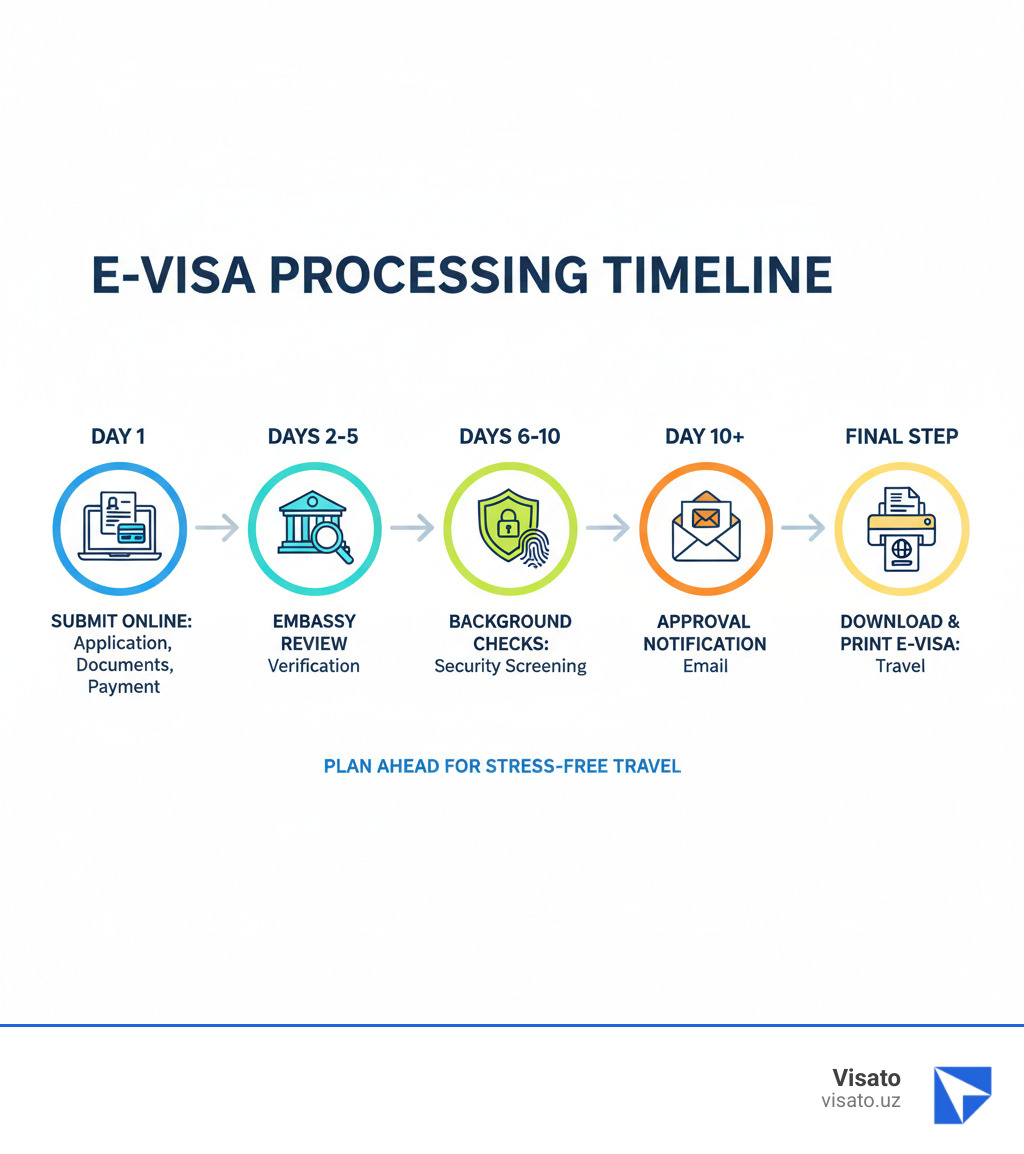
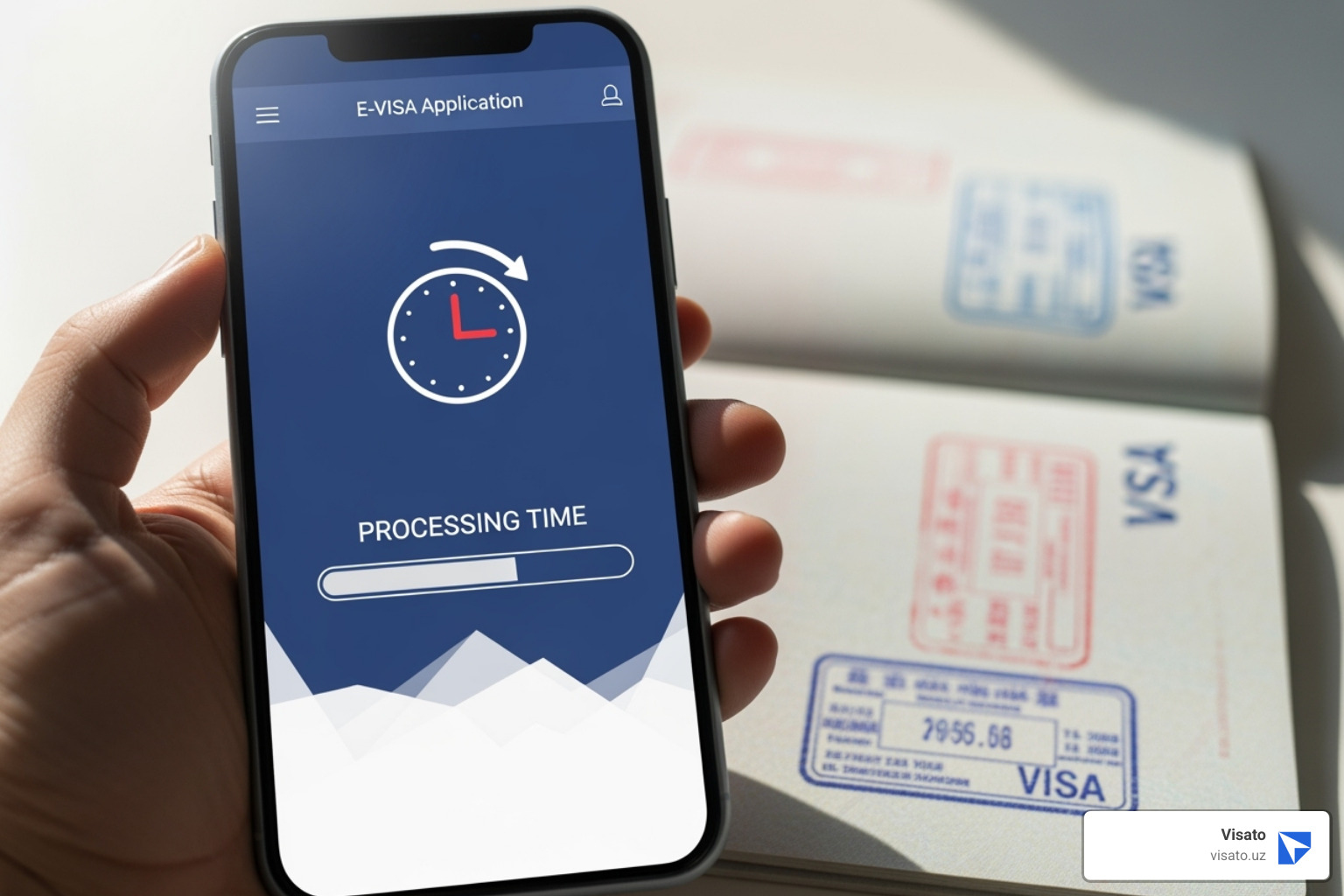
Imagine applying for a visa from home instead of waiting in embassy queues. That’s the convenience of an e-visa, a digital travel authorization that arrives directly in your email. An e-visa is a digital permit to enter a country. The entire process is online: you apply on a government website, upload documents, pay the fee, and receive the approved visa by email. You can then print it or show it on your phone at immigration. This efficiency is why e-visa processing time is typically much shorter than for traditional visas.
The process starts on the official e-visa portal of your destination. You will fill out an application, upload documents like a passport scan and photo, and pay the fee. After submission, immigration officials review your information and conduct checks before making a decision.
Key Requirements Before You Apply
Getting the basics right from the start prevents delays and keeps your e-visa processing time on track.
Your passport validity is crucial. Most countries require at least six months of validity beyond your planned departure date. For example, India requires over 190 days. You’ll also need blank pages for entry and exit stamps, even though the e-visa itself is digital. If your passport is full or expiring soon, renew it before applying.
A compliant digital photo is another key to a smooth application. Most systems require a recent photo (within six months) with a plain white background and clear visibility. A non-compliant photo will cause your application to be sent back for corrections, adding days to your processing time.
Most countries also require proof of funds to show you can support yourself during your visit. This is usually done with recent bank statements. Japan’s e-visa, for instance, requires statements from the last three months.
Finally, check your tech. Use a current browser like Mozilla Firefox, Google Chrome, or Internet Explorer (9.0+). You’ll also need Adobe Acrobat Reader (7.0+) for PDF documents. Most portals are mobile-friendly, allowing you to apply from an Android or iOS device. Checking these technical details beforehand can save you from a lot of frustration.
For a detailed walkthrough, see our E-visa Application Complete Guide. For Uzbekistan specifically, our guide on How to Apply for Uzbekistan Visa Online is a great resource.
When is the Best Time to Apply?
Timing your application is key. Apply too late, and you risk stressful delays. Apply too early, and your visa might expire before your trip.
The golden rule is to start your e-visa application at least 30 days before your departure. This buffer accounts for standard processing times and potential requests for additional information. Brazil’s visa system specifically recommends this 30-day window.
However, different countries have unique rules. India has a minimum 4-day rule, allowing applications between 4 and 120 days before arrival. This offers flexibility for both planners and last-minute travelers, but cutting it close leaves no room for error.
Some countries discourage applying too early. Thailand suggests applying at least one month out but no more than three months in advance. This is because many e-visas are valid from the date of issue, not your entry date. You don’t want your visa to expire before you travel.
Avoiding last-minute stress is the goal. Check your destination’s recommended timeline to ensure your flights, hotels, and visa are all aligned. Give yourself peace of mind by applying early, but not too early.
Decoding the E-visa Processing Time: What to Expect
Now that you understand the application journey, let’s focus on the wait time. The e-visa processing time varies depending on your destination, visa type, and when you apply.
General E-visa Processing Time Averages
Most e-visas are processed within 24 hours to 21 working days. “Working days” exclude weekends and public holidays, so a 5-day turnaround could take a full calendar week or more.
A common pattern is that single-entry visas are processed faster than multiple-entry ones. For the Philippines, a single-entry visa takes 7 to 12 working days, while a multiple-entry visa can take 15 to 21 working days. This is because multiple-entry permissions require more thorough vetting.
| Country | Visa Type | Average Processing Time | Notes |
|---|---|---|---|
| India | e-Tourist, e-Business | 4 days | Apply 4-120 days before travel |
| Vietnam | e-Visa | 4-5 working days | No rush processing available |
| New Zealand | NZeTA | 24 hours (allow up to 3 days) | Electronic Travel Authority |
| New Zealand | Visitor Visa | 1 week (most within 2 weeks) | Standard visitor applications |
| New Zealand | Partner of NZ Citizen Visitor Visa | 6.5 weeks (most within 9 weeks) | Family-related visas take longer |
| New Zealand | Business Visitor Visa | 1 week (most within 1.5 weeks) | Business purposes |
| Philippines | e-Visa (Single Entry) | 7-12 working days | Standard single entry |
| Philippines | e-Visa (Multiple Entry) | 15-21 working days | Multiple entries allowed |
| Japan | e-Visa (Single-entry Tourism) | At least 5 business days | Tourism only, can take longer |
| Thailand | e-Visa | Within 10 business days | Apply 1-3 months ahead |
| Brazil | Visa Application | 30 days recommended (5 business days analysis) | No expedited option |
These are averages, not guarantees. Your actual e-visa processing time can be affected by several factors.
How Different Visa Types Affect E-visa Processing Time
The purpose of your travel significantly impacts the waiting period. Tourist visas are generally the quickest, while business, medical, or family-related visas often require more verification time.
India’s system is a good example. Their e-Tourist and e-Business visas take about 4 days. In contrast, an e-Medical visa has a shorter 60-day validity, and an e-Conference visa is even more restricted. Each category has different requirements that affect processing speed.
New Zealand also shows this variation. Their NZeTA (Electronic Travel Authority) for visa-waiver countries is incredibly fast, averaging 24 hours. A standard Visitor Visa or Business Visitor Visa takes about 1 week. However, a Partner of a New Zealander Visitor Visa averages 6.5 weeks because it requires extensive relationship verification.
When planning, always factor in the specific visa type you need. A quick tourist visa is one thing, but family or medical travel requires building in extra time.
Country-Specific Examples
Let’s look at some real-world examples to help you plan.
India processes most e-visas in about 4 days. You must apply at least 4 days before arrival and can apply up to 120 days in advance. The fee (e.g., USD $80 for Canadian citizens, plus a bank charge) must be paid at least 4 days before travel to start processing. For Indian citizens visiting Uzbekistan, our Uzbekistan E-visa for Indian guide has all the details.
Vietnam typically takes 4 to 5 working days. No express service is available, so planning ahead is essential. For more details, see the official Vietnam E Visa Processing Online FAQ.
New Zealand offers the fast NZeTA, averaging 24 hours (though it’s wise to allow 3 days). Regular visitor visas take about 1 week. You can check current processing times on their official website.
Japan‘s e-visa is only for single-entry tourism stays up to 90 days. The minimum e-visa processing time is 5 business days, but high volume can cause delays. Other visa types require a traditional application at an embassy.
Thailand usually processes e-visas within 10 business days. They recommend applying 1-3 months before travel, as the visa’s validity starts from the issue date.
Brazil recommends applying 30 days before travel. The analysis phase alone takes about 5 business days, and there is no expedited option available.
At Visato.uz, we’ve streamlined the Uzbekistan e-visa process to deliver approvals in as little as 2-3 business days, making your travel planning much easier.
Common Causes for E-Visa Delays and Rejections
Even with online applications, delays can happen. Understanding common pitfalls helps you avoid having your e-visa processing time extend unexpectedly.
E-visa processing can slow down for several reasons. High application volume during peak travel seasons (like summer or major holidays) creates backlogs, delaying all applications.
National holidays in the destination country also cause slowdowns. Visa offices close, and these days do not count as “working days,” adding to your total wait time.
The most common cause of delays and rejections is incomplete forms and incorrect information. Simple mistakes like a typo in your passport number or inconsistent dates can flag your application for a manual review, adding significant time.
For detailed guidance on avoiding these issues, check out our Uzbekistan E-visa Problems Complete Guide.
Top Factors That Influence Processing
Several specific issues can significantly impact your e-visa processing time.
Poor quality photos and documents are a top avoidable problem. E-visa systems require clear, properly formatted digital files. A blurry passport scan or a photo with a patterned background will be flagged. Japan’s system, for example, has strict photo specifications. If your documents don’t meet the standard, you’ll be asked to resubmit, adding days to your wait.
Mismatched information between your application and supporting documents is a major red flag. If your name or travel dates are inconsistent across documents, it will require manual verification. Consistency is key.
Insufficient proof of funds leads to many rejections. If your bank statements don’t clearly show adequate funds for your stay, your application will stall. Japan, for instance, does not accept credit card statements as proof of funds, only bank statements.
Security checks and background verification are standard for every applicant. While most people pass quickly, any issue requiring additional verification (like previous visa problems or a common name) will extend your e-visa processing time. This is part of the authorities’ due diligence.
Your own response time is also a factor. If authorities request more information, the processing clock stops until you reply. A prompt response gets the process moving again quickly.
Finally, some countries have immigration intake limits, or caps on the number of visas issued. As these limits are approached, processing can slow down.
Processing times are estimates. As Canadian immigration authorities explain, the easier it is to verify your information, the faster your application will be processed.
After You Hit ‘Submit’: Tracking Status and Troubleshooting
After submitting your application, the waiting begins. Fortunately, most e-visa systems provide ways to track your application’s progress so you’re not left in the dark.
How to Check Your E-Visa Status
The best place to check is the official government portal where you applied. Countries like the Philippines, Japan, Thailand, and Vietnam have dedicated tracking sections. You’ll typically need your application reference number and passport details to log in. Keep this reference number safe.
Your email inbox is the next place to watch. Most systems send email notifications about your application’s status, whether it’s approved, requires more information, or has been rejected. The Philippine and Thai e-visa systems rely heavily on email updates.
A crucial tip: check your spam folder. Automated government emails often land there. You don’t want to miss an important update, a common issue noted by services like the Thai e-visa portal.
For an Uzbekistan e-visa, our How to Check Uzbekistan Visa Status Online guide simplifies the tracking process.
What to Do if Your E-Visa is Delayed or Rejected
If your e-visa processing time is much longer than the average, or if you receive a rejection, don’t panic. There are steps you can take.
First, contact support. If your application is significantly delayed, reach out to the e-visa help desk. India, Vietnam, and Thailand all offer support channels. Have your application reference number, full name, and passport number ready. Be aware that response times can be several business days during peak seasons.
If your application is rejected, review the rejection reasons carefully. The notice will explain the issue, such as poor document quality or incorrect information. This is crucial for knowing what to fix before you reapply.
Correcting errors and reapplying is often the next step. If the rejection was due to a mistake on your part, you’ll need to start a new application. The Vietnam visa process, for example, suggests this approach. It’s important to know that you typically cannot edit an application after submission. The Thai e-visa system is clear on this: incorrect information requires a new application and another fee. Double-check everything before you submit.
Unfortunately, expedited processing is rarely an option for e-visas. Countries like Japan, Vietnam, and Brazil do not offer fast-track services. New Zealand may escalate urgent applications in specific cases, but this is not a standard paid service. Staying organized and knowing where to find updates is your best strategy for a manageable waiting period.
Frequently Asked Questions about E-Visas
Here are answers to some of the most common questions about the e-visa process.
Are e-visa fees refundable if my application is denied?
No, e-visa fees are almost never refundable, regardless of the outcome. The fee covers the administrative cost of processing your application, which occurs even if the visa is denied. Official policies for countries like the Philippines and India state that fees are non-refundable. Additionally, some systems, like the Philippines’, require payment within a short window (e.g., 48 hours) or the application is canceled, forcing you to start over.
Can I extend my e-visa or convert it to another type?
Generally, e-visas cannot be extended or converted to other visa types after you arrive in the country. They are intended for short-term visits with a fixed duration. The Philippines’ e-visa, for example, cannot be converted, and the stay cannot be extended. If you might need to change your visa status, you should apply for a traditional Machine Readable Visa (MRV) before you travel.
Thailand has similar rules; you cannot renew a visa and must apply for a new one. An extension of stay must be handled in person with the Immigration Bureau in Thailand. India requires long-term visa holders staying over 180 days to register with the Foreigners Regional Registration Office (FRRO), which is a registration, not an extension.
Plan your visa type and duration carefully from the start. Our Uzbekistan Visa Types 2025 guide can help you understand different visa categories.
Are there options for expedited e-visa processing?
For most e-visas, expedited processing is not an option. E-visas are already considered the faster alternative to traditional applications.
Japan, Vietnam, and Brazil explicitly state they do not offer expedited services for their e-visa programs. New Zealand has an escalation process for truly urgent cases, but this is not a standard service you can purchase.
The best way to get your visa quickly is to apply well in advance (at least 30 days is recommended), double-check all your information, and ensure your documents meet all requirements. A complete and accurate application is always the fastest path to approval.
At Visato.uz, we have optimized the Uzbekistan e-visa process to provide approvals in just 2-3 business days. However, even this fast service depends on a correct and complete application. Advance planning and accuracy are the real shortcuts to a faster e-visa processing time.
Conclusion: Plan Ahead for a Smooth Journey
Understanding e-visa processing time is essential for a relaxed journey. As we’ve seen, timelines vary dramatically, from New Zealand’s 24-hour NZeTA to the Philippines’ three-week wait for certain visas. There is no single answer, but planning is key.
Success hinges on three principles: accuracy, timing, and awareness. A complete and correct application, with clear documents and a valid passport, is essential to avoid delays. Details like having six months of passport validity and blank pages are critical.
Timing is just as important. The 30-day advance application window is your insurance policy against stress from unexpected technical glitches or document requests. We’ve also seen that the visa type matters; tourist visas are generally faster than business or family-based ones.
Expedited processing is not a standard feature for e-visas, which makes early and accurate applications even more critical. Since fees are almost always non-refundable, getting it right the first time saves both time and money.
At Visato.uz, we specialize in helping travelers steer these requirements. Proper planning turns visa applications from a source of anxiety into a simple checklist item. For travelers heading to Uzbekistan, we’ve streamlined the process to deliver e-visas in just 2-3 business days, backed by 24/7 support. We handle the complexity so you can focus on your trip.
The bottom line is to not leave your visa to chance. Check requirements early, prepare your documents carefully, and apply with plenty of time to spare. The peace of mind is well worth the effort.
Ready to apply for your next adventure? Check out the full Uzbekistan E-visa Requirements to ensure a hassle-free experience.