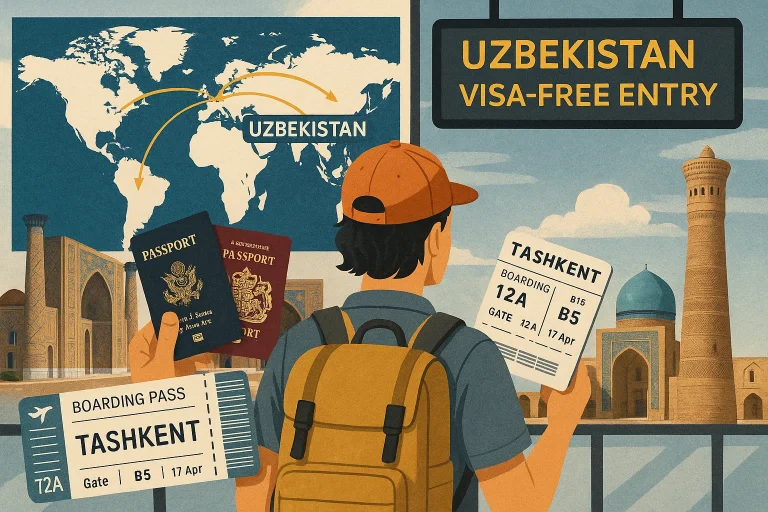
This page follows the active Uzbekistan eVisa application screen for the Hong Kong passport option. That screen currently states three operational points: the visa is for 30 days, processing is three working days excluding weekends and holidays, and the form must be completed in English. The guide applies those instructions to Hong Kong passport names, document images, HKD card payment, connections, and entry selection.
Quick answer: A Hong Kong passport holder can prepare a 30-day Uzbekistan eVisa through the active application route. Enter the passport’s English identity fields, upload a separate facial photograph and complete bio-page image, and do not count Saturday, Sunday, or holidays as processing days.
Apply for Uzbekistan eVisa for Hong Kong citizens
Get the correct document checklist, processing guidance, and application support for your nationality.
- Document and photo guidance
- Secure application handoff
- WhatsApp support available
Current portal instruction: Visa for 30 days. Processing time is 3 working days, not including weekends and holidays. Fill out the form in English only.
Price and entry choice for this itinerary
The displayed application products are paid in USD. A Hong Kong card may convert from HKD and add a cross-border cost. Entry type must cover every return to Uzbekistan during a wider Central Asia itinerary.
| Entry type | Total application price | Use it when |
|---|---|---|
| Single entry | USD 60 | The itinerary enters Uzbekistan once and does not return after leaving. |
| Double entry | USD 75 | The traveler leaves Uzbekistan and returns one more time. |
| Multiple entry | USD 120 | The confirmed route requires three or more entries during validity. |
Build the application around the real trip
A useful visa page should lead to a decision, not merely repeat a country name. For a traveler from Hong Kong Island, Kowloon, the New Territories, and outlying islands, that decision begins with the passport, actual route, entry count, and ability to complete payment. Prepare those facts before opening the form. If the route changes, update the plan deliberately rather than leaving the visa choice based on an old itinerary.
Review eligibility again close to payment because immigration and airline rules can change. Keep the passport, submitted files, application code, payment record, and issued document together. A well-organized record makes it easier to answer an airline question, understand a status issue, or correct a genuine mistake without creating unnecessary duplicate applications.
Planning the route from Hong Kong to Tashkent
Hong Kong travelers can use direct services on selected schedules or connect through mainland China, Seoul, Bangkok, Istanbul, the Gulf, or another hub. Check the operating flight, transit permission, baggage transfer, and actual arrival date before applying.
The useful starting point is the final sector into Uzbekistan, not the time the traveler leaves home. A late-night departure from Hong Kong can arrive on a different calendar day after one or two connections. Enter the actual Uzbekistan arrival date shown by the confirmed itinerary. Separate tickets can require baggage collection, immigration, and a new check-in in the connection country. That country applies its own rules to the Hong Kong SAR passport. If the journey later leaves Uzbekistan for Kazakhstan, Kyrgyzstan, or Tajikistan and returns to Tashkent, count the return as another Uzbek entry before selecting single, double, or multiple entry.
Flight schedules change, so examples are planning patterns rather than promises of a current direct service. The safest approach is to check the actual operating carrier, airport, terminal, connection type, baggage transfer, and entry permission for each date. The visa application should reflect the confirmed Uzbekistan arrival rather than an assumed timetable.
English-only fields and the Hong Kong passport
Use the English surname and given names printed on the passport identity page. Do not enter Chinese characters in an English field and do not translate a name from memory. A local identity card, work badge, airline profile, or nickname is not the source for the visa identity. Compare the visible English fields with the machine-readable zone before payment.
Airline systems may join given names or remove spaces. That display should be discussed with the carrier, but it does not authorize a different visa spelling. Check passport number, date of birth, nationality, issue date, expiry date, and email on a full preview.
English-only form and Hong Kong passport names
The passport is the controlling source for the traveler’s international identity.
The active portal specifically instructs Hong Kong applicants to complete the form in English only. Use the English surname and given names printed on the passport identity page. Do not enter Chinese characters in an English field, translate a name from memory, or insert a nickname used at work. Hong Kong airline records sometimes join given names or omit spaces, but the visa application should follow the passport fields. Compare the visible identity page and machine-readable zone, then review the passport number, birth date, nationality, issue date, and expiry date before payment. A local Hong Kong identity card is not the source for the international visa identity.
When a travel agent or relative fills the form, ask them to provide a screenshot or complete preview before payment. The applicant should not approve only the price; the applicant should approve the name, passport number, dates, nationality, entry count, email, and uploaded files. Shared responsibility is useful, but the traveler ultimately carries the document at the border.
What the three-working-day processing notice means
An eVisa application and an airport transit arrangement are different routes. A Hong Kong passport holder entering Uzbekistan for a planned visit should prepare the visa shown by the active application portal rather than treating a normal holiday as transit.
The portal displays a processing time of three working days and expressly excludes weekends and holidays. A submission late on Friday should not be counted as if Saturday and Sunday were processing days. Uzbekistan public holidays and operational review can also affect the practical calendar. Treat three working days as the stated processing period, not a promise that every result will arrive at the same hour. Submit with a sensible buffer before departure, monitor the application email, and keep the application code and payment record. Do not create repeated applications merely because a weekend passes without an update.
Transit information should be checked close to travel because airline participation, route conditions, and government rules can change. Keep proof of the onward ticket and any required connection-country authorization. If the itinerary is a normal Uzbekistan visit rather than a qualifying transit, apply under the correct route instead of trying to fit the trip into a narrower exception.
Three working days on a real calendar
The portal’s three-working-day notice excludes weekends and holidays. A Friday submission should not be counted as if Saturday and Sunday were review days. Public holidays can also change the practical calendar. Use the official working-day wording as a processing period rather than a promise that every result arrives at the same hour.
Apply with a sensible buffer, keep the application code and payment record, and monitor the correct email address. Do not create duplicate applications merely because a weekend passes without a result. First verify submission date, payment outcome, and the calendar.
Hong Kong SAR passport versus other documents
Eligibility follows the travel document selected in the application. A Hong Kong resident may hold an HKSAR passport, a British National (Overseas) passport, a mainland Chinese passport, a foreign passport, or another document. Residence in Hong Kong does not make those documents interchangeable. This page concerns the Hong Kong passport option shown by the electronic application portal. A traveler using another nationality should follow the rule for that passport and should not select Hong Kong simply because the journey begins at Hong Kong International Airport. Use the same passport for the application, airline booking, check-in, entry, and departure.
Preparing the facial photo and passport page
Prepare two separate image files: a recent front-facing facial photograph and a readable color image of the complete passport bio-page. Do not use the small portrait cropped from the passport as the facial photo. Hong Kong passports include security patterns and reflective surfaces that can produce glare, so place the document flat and keep the camera parallel to the page. Check the English text, passport number, photograph, and machine-readable lines after compression. Messaging apps can reduce image quality. Open the exact final files on a larger screen before upload and confirm that no finger, shadow, flash reflection, or crop hides important details.
HKSAR passport, BN(O), and other passports
Hong Kong residence does not make every travel document equivalent. A resident may hold an HKSAR passport, BN(O) passport, mainland Chinese passport, or another country’s passport. This page concerns the Hong Kong passport selection shown by the electronic portal. A traveler using another document must follow the rule for that passport.
Choose one passport for the application, airline booking, check-in, entry, and departure. A Hong Kong identity card does not replace that international travel document. Dual nationals should make the choice before payment rather than switching passports at the airport.
Paying from an HKD bank account
A Hong Kong-issued Visa or Mastercard can still be declined even when the account has enough funds. The issuing bank may treat the payment as an international online transaction, require an app confirmation, send a one-time code, or block the merchant until overseas e-commerce is enabled. The displayed amount is in USD, so the final HKD debit can include the bank exchange rate and a cross-border fee. Use one stable browser session and avoid pressing the payment button repeatedly. Save the successful payment record with the application code. When another person pays, keep the traveler identity and cardholder identity separate.
Direct flights, connections, and self-transfer risk
Schedules between Hong Kong and Central Asia change by season. A route shown as convenient today may use a different operating day, airport, or carrier at the time of travel. Through-tickets usually protect the connection and transfer checked baggage, while separate tickets can leave those responsibilities with the passenger. Verify whether a connection in mainland China, South Korea, Thailand, Turkey, or a Gulf state remains airside. An Uzbekistan eVisa authorizes the Uzbek part of the journey; it does not grant entry to every connection country. Leave enough time for terminal changes and manual document checks.
HKD card approval and cross-border charges
A Hong Kong-issued card can be declined even with enough balance. The bank may require an app approval or one-time code, or it may block overseas e-commerce until the setting is enabled. The final HKD debit can reflect the issuer’s exchange rate and foreign transaction charge.
Use one stable browser session and avoid pressing Pay repeatedly. Save the completed transaction record with the application code. If another person pays, keep the traveler identity and cardholder identity in their correct roles.
Regional Silk Road trips and entry count
A Hong Kong traveler may combine Uzbekistan with Kazakhstan, Kyrgyzstan, Tajikistan, or another nearby country. Visiting Tashkent, Samarkand, Bukhara, and Khiva without leaving Uzbekistan uses one entry. Crossing into Kazakhstan and later returning to Uzbekistan uses a second entry, even when the return is only to catch the flight home. Write the route as a sequence of international border crossings before choosing the product. A single-entry eVisa should not be selected merely because the traveler spends most nights in Uzbekistan. Match the document to the complete itinerary, including any return after a regional side trip.
Families, dual nationals, and consistent passports
Every traveler needs an individual document review. A parent using an HKSAR passport may travel with a child who holds a different passport, and the child should not automatically be assigned the parent passport route. Dual nationals should decide which passport supports the Uzbekistan journey before applying and keep the airline booking consistent with that choice. Store each facial photo, passport scan, application code, and result in a separate folder. Similar English names can make family uploads easy to mix up, so compare the image and passport number after every upload rather than reviewing the group only at the end.
Direct services, seasonal schedules, and regional returns
Flight schedules between Hong Kong and Central Asia can change by season. Confirm the operating carrier and date instead of relying on an old route example. Connections through mainland China, Seoul, Bangkok, Istanbul, or the Gulf have their own transit and baggage rules. Separate tickets can require entry into the hub country.
Tashkent-Samarkand-Bukhara-Khiva stays within one Uzbek entry. Leaving for Kazakhstan, Kyrgyzstan, or Tajikistan and returning to Uzbekistan creates another entry. Write the border sequence before selecting single, double, or multiple entry.
Preparing Hong Kong passport and facial images
Create two files. The first is a recent front-facing facial photograph against a simple light background. The second is a clear color capture of the complete Hong Kong passport bio-page. Do not reuse the small portrait printed inside the passport as the separate facial photograph.
Passport security patterns and reflective surfaces can produce glare. Place the document flat, keep the camera parallel, and move the light until the English name, passport number, photograph, dates, and machine-readable lines are unobstructed. Review the final compressed versions, not only the originals. A file that uploads successfully can still be too blurred for reliable reading.
Keep Chinese-character records outside the English-only form unless a field expressly requests them. The application’s identity check should remain consistent with the English passport details from start to finish.
What to inspect when the 30-day eVisa arrives
Compare the result with the exact passport used in the application. Check English surname and given names, passport number, nationality, date of birth, validity, and permitted entry type. The portal’s “visa for 30 days” wording concerns the visa route; the traveler should still read the dates printed on the issued document and plan departure with a buffer.
Save the PDF offline and print a copy. Carry the application passport even when another travel document is also useful for a connection. Do not edit the visa file or switch passports at the Uzbekistan check-in desk. If a material identity error appears, obtain guidance before travel.
Review the flight schedule again after approval. A changed connection can introduce a new transit requirement even though the Uzbekistan document itself remains unchanged.
Hong Kong application mistakes to avoid
Do not enter Chinese characters where the portal requires English, do not use a Hong Kong identity-card number as the passport number, and do not select Hong Kong merely because a foreign-passport holder lives there. Avoid counting a weekend as part of the stated three working days. Do not choose single entry for a trip that leaves Uzbekistan and returns.
Keep the form tied to one travel document. When a BN(O), mainland Chinese, or another foreign passport will be used, follow that passport’s route rather than mixing its details with the Hong Kong passport option.
Questions specific to this passport and route
What duration does the portal show for Hong Kong?
The active application screen states a visa for 30 days.
How is the processing period counted?
The portal states three working days and excludes weekends and holidays from that count.
Can the form be completed in Chinese?
The current instruction says to complete the form in English only.
Does a Hong Kong identity card replace the passport?
No. Use the international travel document selected for the application and journey.
Can an HKD card pay the USD amount?
It may, subject to conversion, international e-commerce controls, and bank verification.
Does a return from Kazakhstan require another entry?
Yes. Crossing back into Uzbekistan after leaving is another entry.